Storm Damage Restoration for Seminole homes
Bayline Restoration Co. provides residential storm damage restoration throughout Seminole, Pinellas County. Emergency tarping, board-up, water extraction, and debris cleanup after hurricanes, tropical storms, and severe weather. We are an independent direct provider based in Tampa Bay, which means the crew assessing your Seminole home is the crew doing the work, and we answer the phone twenty four hours a day.
Seminole is a mid-county Pinellas community with a heavy concentration of single story block homes, retirement and fifty five plus communities, and easy access to the beaches to the west. The typical restoration call here involves an older home with original or first-generation replacement plumbing, an air conditioning system working hard against coastal humidity, and owners who want the job done carefully and explained clearly rather than rushed.
Local conditions shape how this specific service is performed here. Standard Pinellas coastal humidity and wet season rainfall, with beach proximity contributing salt air exposure to exterior equipment. Combine that with the housing profile in Seminole and you get a distinct pattern of what fails, how fast it spreads, and what can realistically be saved. Largely single family block construction from the nineteen sixties through the nineteen eighties, plus villa communities, condominiums, and manufactured home parks. Slab-on-grade construction is the norm, which affects how water spreads during a loss.
Seminole conditions that affect storm damage restoration
Seminole sits between the Intracoastal beaches and central Pinellas, at moderate elevation with proximity to Boca Ciega Bay. Rainfall flooding in low drainage areas is more common here than surge inundation, though coastal exposure is close by.
Those conditions change the technical plan. Equipment placement, how aggressively we dehumidify, whether materials can be dried in place or need to come out, and how long verification takes are all influenced by the environment surrounding the structure rather than by the loss alone.
- Slab leaks in mid-century block homes
- Aging water heaters reaching end of life
- Air conditioning condensate overflow into hallways and closets
- Roof leaks on aging shingle systems
- Humidity related mold in closed or seasonal homes
- Manufactured home water losses in park communities
What causes storm damage restoration work in a home
Understanding the cause matters because the cause dictates the scope. Two properties with identical visible damage can require completely different work depending on how the damage occurred and how long the condition persisted. These are the situations we respond to most often in Tampa Bay:
- Hurricane and tropical storm wind uplift on roof coverings
- Wind-driven rain intrusion around windows, doors, and flashing
- Falling trees and limbs penetrating roof decking
- Flood and storm surge in low-lying coastal areas
- Hail impact on roofing, vents, and rooftop equipment
- Lightning strikes causing fire and electrical damage
- Failed soffits and gable vents allowing attic water intrusion
- Blocked drainage and gutter overflow during heavy rainfall
Why fast, correct action matters
Delay is the single largest cost multiplier in restoration work. The difference between responding within hours and responding within days is frequently the difference between drying and cleaning materials in place versus removing and rebuilding them. In a coastal Florida climate, ambient conditions work against you nearly every month of the year, so problems that might resolve on their own in a dry region simply do not here.
- An unsecured roof breach keeps taking water with every rain band
- Saturated ceiling assemblies can collapse without warning
- Wet insulation loses value and holds moisture against framing
- Standing floodwater is often contaminated and requires different handling
- Electrical systems exposed to water present shock and fire hazards
- Delays in documentation weaken the insurance claim after the fact
Signs your home needs professional attention
Not every problem announces itself. Many of the calls we take start with a homeowner noticing something subtle and deciding to investigate rather than wait. These indicators are worth acting on:
- Missing, lifted, or creased shingles visible from the ground
- Water staining on ceilings or along the top of interior walls
- Daylight visible in the attic or wet insulation after a storm
- Debris in gutters combined with overflow staining on fascia
- Damaged soffits, fascia, or displaced roof vents
- Wet carpet along exterior walls or under windows
Our storm damage restoration process
We work through a defined sequence on every project. The sequence exists because skipping or reordering steps is what causes work to be redone, and redone work is paid for twice.
- Step 1
Emergency stabilization
Crews tarp roof breaches, board openings, and remove immediate hazards so the structure stops taking on water. Stabilization is the single highest-value hour of a storm response because everything downstream depends on it.
- Step 2
Hazard assessment
The property is evaluated for electrical hazards, compromised structure, and contaminated water before anyone works inside. Storm water that has contacted ground runoff or sewage is treated as contaminated.
- Step 3
Water extraction
Standing water is removed with truck-mounted and portable units, and saturated carpet, pad, and porous materials are pulled where they cannot be dried in place.
- Step 4
Debris removal and demolition
Downed limbs, damaged materials, and unsalvageable contents are removed and documented. Wet insulation and compromised drywall come out so the cavity can be dried.
- Step 5
Structural drying
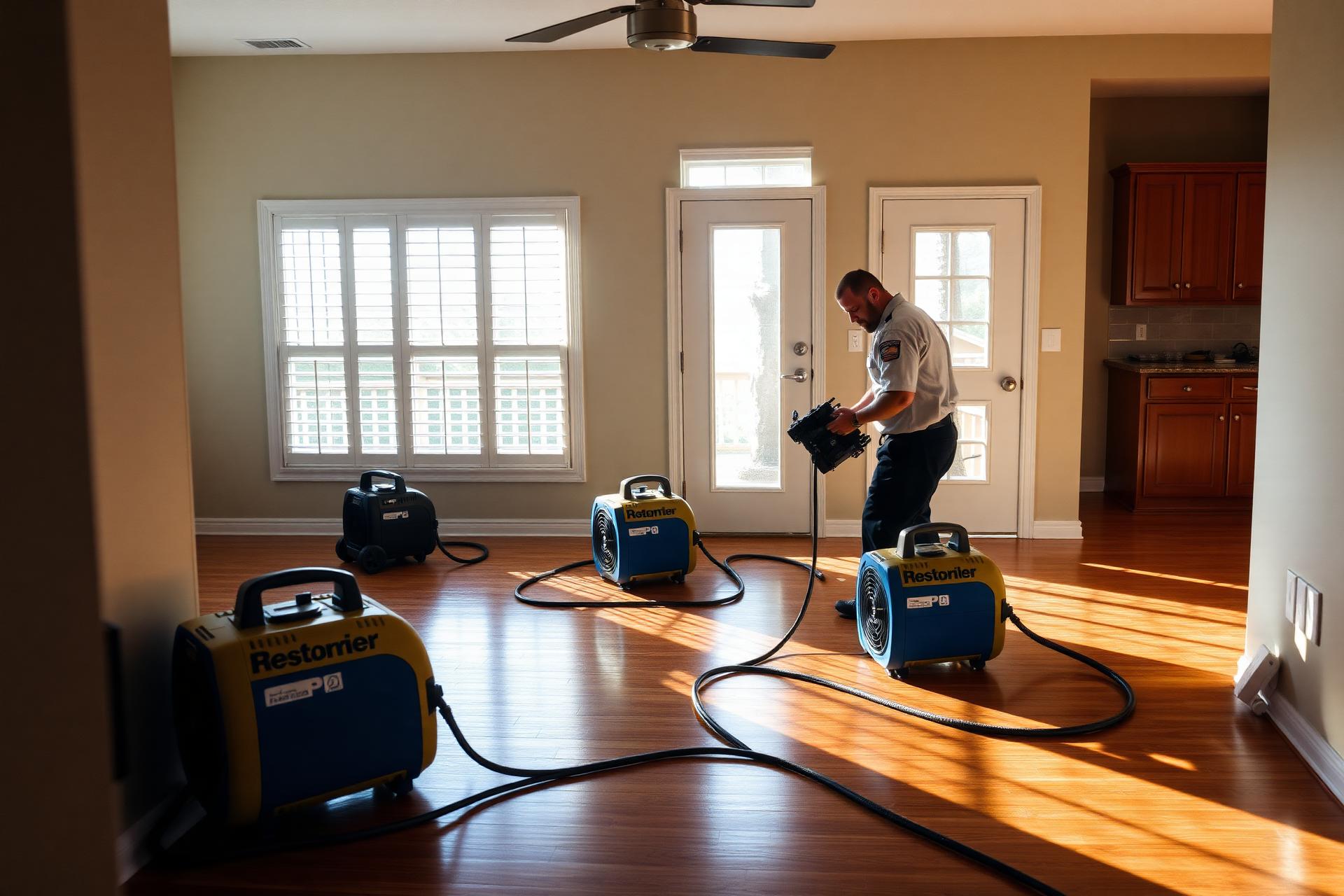
Air movers and dehumidifiers are deployed by affected volume and material class, and readings are logged daily until the structure reaches dry standard.
- Step 6
Microbial prevention
Affected surfaces are cleaned and treated so the window between storm and rebuild does not become a mold problem, which is the most common secondary loss after a hurricane.
- Step 7
Insurance documentation
Photographs, moisture logs, material inventories, and a line-item scope are compiled for the claim. Storm claims are volume events for carriers and thorough documentation moves faster.
- Step 8
Repair and reconstruction
Roof, envelope, and interior finishes are rebuilt so the property is returned to pre-loss condition rather than left in a stabilized but unfinished state.
Equipment and methods we use
Professional results depend on professional equipment used correctly. Rental units and consumer tools are not sized, instrumented, or filtered the same way, and the gap shows up in outcomes rather than in the first hour of work.
- Reinforced tarping systems and board-up materials
- Truck-mounted and portable extraction units
- Commercial dehumidifiers and high volume air movers
- Generators for properties without power
- Moisture meters and thermal imaging
- Debris handling and containment equipment
- HEPA air scrubbers
- Antimicrobial application systems
Standards we work to
Storm work follows the same drying science as any water loss, with the addition of envelope stabilization first and contamination assessment for any water that has contacted ground runoff. We document before mitigation because the pre-mitigation condition is what the claim is evaluated against.
Bayline Restoration Co. is an independent direct provider, which means the crew that assesses your home is the crew that performs the work. There is no national call center routing your address to whichever contractor happens to be available, no lead fee baked into your invoice, and no gap between what was promised on the phone and what shows up in the driveway. When you call, you reach people who work in Tampa Bay and who will be standing in your building.
That structure matters most when something goes wrong or the scope changes mid-project. A single accountable team means one set of documentation, one point of contact, and one party responsible for the result. We answer the phone twenty four hours a day because water, smoke, and storm damage do not observe business hours, and the first few hours of a loss determine most of what the repair will ultimately cost.
Residential scope we handle
Residential projects in this category regularly include the following. If your situation is not listed, it is still worth a call, because most of what we do is a variation on these scenarios.
- Roof tarping and emergency board-up
- Attic water intrusion and insulation removal
- Interior drying after wind-driven rain
- Flood water extraction in ground level living space
- Fallen tree impact cleanup and structural protection
- Full documentation for hurricane and windstorm claims
What to do before we arrive
There are useful things you can do in the first hour, and there are things that make the job harder. This list covers both.
- Stay out of the property until it is confirmed structurally and electrically safe
- Photograph all damage from the exterior and interior before cleanup
- Report the claim to your carrier as early as possible
- Cover openings if it can be done safely, and keep receipts for materials
- Do not run electrical equipment in standing water
- Move undamaged contents to a dry, secured area
- Keep a written log of who visited the property and when
Common mistakes to avoid
These are the errors we are called in behind most often. None of them are unreasonable choices in the moment, and all of them cost money later.
- Step 1
Waiting for the adjuster before stabilizing
Most policies obligate the owner to prevent further damage. Delaying a tarp until an adjuster visits allows days of additional water intrusion that may not be covered.
- Step 2
Signing with the first door knocker
After named storms, out-of-area crews flood the region. Verify licensing, insurance, and local presence, because the party you sign with may not be the party that performs the work.
- Step 3
Cleaning up before documenting
Debris removed before photographs are taken effectively disappears from the claim.
- Step 4
Ignoring attic insulation
Wet blown-in insulation holds water against framing and ceiling drywall for weeks and is a leading cause of post-storm mold.
- Step 5
Treating floodwater as clean water
Water that has moved across the ground carries contaminants and requires different handling, protective equipment, and material disposal decisions.
How long the work takes
Stabilization happens the day we can safely access the property. Extraction and drying then run the same three to seven day arc as any water loss, though storm season demand and utility outages can extend it. Reconstruction after a named storm is the long pole, because material availability and permitting across an entire region are affected at once. We are honest about that timeline rather than promising dates the supply chain will not support.
Every project starts with a conversation about what happened, followed by an on-site assessment. We walk the affected areas with instruments rather than assumptions, define the actual scope, and explain what we found in plain language before any equipment comes off the truck. You will know what we plan to do, roughly how long it will take, and what drives the cost.
From there the work proceeds in documented phases. We photograph conditions, log readings where the job involves moisture, and provide updates as the project moves. When the scope needs to change because we discovered something behind a wall, we tell you before we act on it, not after. At completion you receive a documentation package covering the storm damage restoration that is suitable for your records or your insurance carrier.
Insurance and documentation
Windstorm and hurricane claims frequently carry separate deductibles and stricter documentation expectations, and flood is a distinct policy entirely. We photograph pre-mitigation conditions, log moisture readings, and produce line-item scopes so the file is complete. Do not wait for an adjuster to authorize emergency mitigation. Policies generally require the property owner to prevent further damage, and stabilization is exactly that.
We do not tell you what your carrier will or will not pay, because that is their decision and your policy. What we control is the quality of the record: photographs taken before anything is disturbed, instrument readings logged over time, a line-item scope tied to the work actually performed, and a clear explanation of every item on it. A well documented file is the most effective thing a homeowner can bring to a claim conversation.
Preventing a repeat
Once the immediate problem is resolved, the useful question is how to keep it from happening again. These measures address the conditions behind most of the calls we take:
- Have the roof inspected before hurricane season and repair flashing early
- Trim trees back from the structure and remove weak limbs
- Clear gutters and confirm downspouts discharge away from the foundation
- Install or service window and door protection
- Secure loose exterior items before a storm arrives
- Photograph the property annually so pre-loss condition is documented
Storm Damage Restoration questions we hear most
These are the questions homeowners ask us most often about storm damage restoration. If yours is not covered here, call and ask. We would rather answer a question than have you guess.
Should I wait for my insurance adjuster before calling you?
No. Policies generally require you to take reasonable steps to prevent further damage, and emergency tarping and extraction are exactly that. We document conditions before we mitigate so the adjuster sees the original state.
Is flood damage covered by my homeowners policy?
Typically not. Flood is a separate policy, usually through the National Flood Insurance Program or a private flood carrier, while wind-driven rain entering through a storm-created opening is generally handled under the property policy. Documentation of how water entered matters.
How fast can you get out after a hurricane?
We are a local Tampa Bay crew, so we are not staging in from out of state. Access after a named storm depends on road conditions and utility status, and we work in the order calls come in with life safety and active intrusion prioritized.
Do you handle the roof repair too?
We handle emergency tarping and stabilization and coordinate permanent roof repair as part of the reconstruction scope so the interior work is not undone by an unresolved breach.
What if the power is out?
We bring generators. Drying equipment is useless without power, and after major storms utility restoration can lag for days, so self-powered mitigation is part of storm response.
How long will drying take after storm flooding?
Typically three to seven days of monitored equipment, longer if flood water contacted dense assemblies or if humidity remains extreme across the region.
Neighborhoods we cover for storm damage restoration in Seminole
We provide this service across all of Seminole, including these areas:
- Bay Pines area
- Lake Seminole
- Oakhurst
- Ridgewood Groves
- Seminole Grove Estates
- Tanglewood
Getting a crew to your Seminole property
Seminole is centrally located in our Pinellas coverage and is typically among the fastest addresses for our mid-county crews to reach.
Reference points we route around in and near Seminole include Seminole City Center, Lake Seminole Park, Seminole Recreation Center, Park Boulevard corridor, and the surrounding corridors. We serve ZIP codes 33772, 33776, 33777, 33778 and the adjacent areas of Pinellas County.
Bayline Restoration Co. is an independent direct provider, which means the crew that assesses your home in Seminole is the crew that performs the work. There is no national call center routing your address to whichever contractor happens to be available, no lead fee baked into your invoice, and no gap between what was promised on the phone and what shows up in the driveway. When you call, you reach people who work in Tampa Bay and who will be standing in your building.
That structure matters most when something goes wrong or the scope changes mid-project. A single accountable team means one set of documentation, one point of contact, and one party responsible for the result. We answer the phone twenty four hours a day because water, smoke, and storm damage do not observe business hours, and the first few hours of a loss determine most of what the repair will ultimately cost.
Don't Let It Spread. Call Now.
24-hour response across Tampa Bay. Speak with the crew that does the work.